






Discovering how your house can fund your biggest dreams takes just a quick look at your current property value and loan balance. Homes build wealth quietly while you enjoy everyday life, turning past mortgage payments into usable cash potential.
Knowing how much home equity can you borrow keeps you from guessing when planning kitchen renovations or consolidating debt. Most lenders cap total borrowing at 80% to 85% of your property’s value minus your current balance, though stellar credit can sometimes unlock up to 90% or 95%.
Why Knowing Your Home Equity Limits Matters
Understanding your borrowing boundaries helps you plan major moves without risking your financial peace of mind.
Thinking of your house as a giant piggy bank is fun until you realize you cannot just smash it open with a hammer. Learning how much home equity can you borrow prevents awkward rejections when applying for home improvement funds. Knowing your ceiling upfront ensures you shop for realistic loan amounts while keeping your monthly household budget completely safe and stress-free.
How to Calculate Your Limit
Calculating your available equity takes four straightforward steps using basic household numbers.
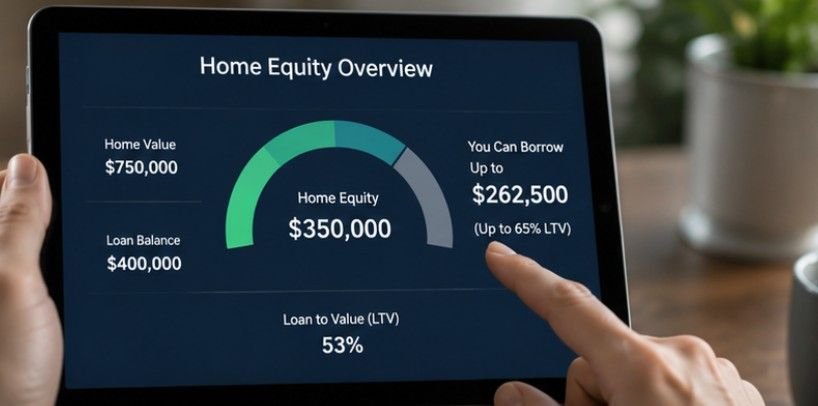
Find Home Value
Your calculation starts with a realistic picture of what your property is worth in today’s active real estate market. Online estimation tools give a handy baseline, but lenders rely on certified professional appraisals to set the official benchmark. Recent neighborhood sales, physical upgrades, and local housing trends directly shape this core figure.
Check Mortgage Balance
Next, log into your loan account or call your lender to verify your exact remaining primary mortgage payoff amount. This figure represents the original loan balance you still owe to your main lien holder. Keeping this number precise ensures your final borrowing math stays accurate throughout the underwriting process.
Apply the Limit Ratio
Lenders protect themselves by capping combined debt using a Combined Loan-to-Value ratio, usually set between 80% and 85%. Multiply your home value by this percentage to establish the total maximum debt allowed on the property. For example, an 80% limit on a $400,000 home sets a maximum combined threshold of $320,000.
Subtract the Mortgage
To determine how much home equity can you borrow, take your maximum allowed debt ceiling and subtract your current mortgage balance. If your limit is $320,000 and you owe $200,000, your usable borrowing limit equals $120,000. This final dollar amount becomes your available line of credit or second loan cap.
Rules That Change the Amount
Personal financial metrics strongly influence whether a lender offers the maximum standard borrowing percentage.

Credit Score Impact
Your credit score serves as the primary gauge of financial responsibility in the eyes of mortgage underwriters. Higher credit scores signal lower risk, prompting banks to approve higher loan percentages up to 90% or 95%. Maintaining strong credit habits keeps borrowing limits high while unlocking significantly lower interest rates.
Income and Debt Ratios
Lenders evaluate your monthly gross earnings against ongoing debt payments to confirm you can handle a second payment. This calculation, known as the debt-to-income ratio, generally needs to stay below 43% for standard approval. Keeping personal debt low ensures your monthly cash flow supports a new credit line without financial strain.
Specific Lender Guidelines
Every bank, credit union, and online lender establishes its own internal risk tolerance and borrowing caps. While traditional banks stick firmly to an 80% limit, local credit unions often extend higher limits to qualified members. Shopping around across multiple institutions helps you secure the most generous equity caps available.
Common Mistakes When Borrowing Against Home Equity
Avoiding common borrowing mistakes can save you from financial stress and help you make the most of your home’s value. Before applying for a home equity loan or HELOC, understanding these pitfalls can protect both your finances and your property.

Borrowing More Than You Actually Need
One of the biggest mistakes homeowners make is borrowing the maximum amount they’re approved for simply because it’s available. While higher borrowing limits may seem tempting, taking on unnecessary debt increases your monthly payments and total interest costs. Borrow only what you need for your intended purpose and leave some equity untouched as a financial safety net.
Ignoring the Total Cost of the Loan
Many borrowers focus only on the monthly payment without considering the overall cost of borrowing. Interest rates, closing costs, appraisal fees, and repayment terms all affect the total amount you’ll repay. Comparing multiple lenders and reviewing the complete loan estimate helps you avoid expensive surprises.
Overlooking Your Financial Stability
Using home equity without considering future income changes can create repayment challenges. Before borrowing, evaluate your job security, emergency savings, and existing debt obligations. Since your home serves as collateral, missing payments could put your property at risk. Careful planning ensures your home equity works as a financial tool rather than becoming an added burden.
Frequently Asked Questions
1. What is the monthly payment on a $50,000 home equity loan?
At an 8% fixed interest rate over a 15-year repayment schedule, a $50,000 loan costs about $478 per month in principal and interest.
2. What is the maximum amount I can borrow with a home equity loan?
Determining how much home equity can you borrow typically means capping combined debt at 80% to 85% of appraised value minus your mortgage.
3. What is the downside of taking a home equity loan?
Your property serves as direct collateral, so failing to make payments could risk foreclosure while increasing your overall monthly fixed debt load.
4. How is a $50,000 home equity loan different from a $50,000 home equity line of credit?
A loan provides a fixed lump sum with stable monthly payments, whereas a HELOC acts as a flexible credit line with variable rates.
Ready to Turn Your Brick and Mortar into Financial Power?
Knowing how much home equity can you borrow gives you the confidence to tackle major financial goals on your terms. Whether you plan home additions or smart debt payoff, calculating your limits keeps you in complete control. Check your numbers today, compare lender caps, and make your property’s built-up value work for your future.